Measure the damage first
Size picks the technique. Openings under about four inches take a self-contained plug. Up to around eight inches, a squared patch with an internal cleat. Past that, the cut is usually extended out to the framing members on each side so the insert is screwed to framing along both edges.
A full sheet starts to win when damage covers a big share of one four-by-eight panel, or several separate holes sit on that same panel. One new sheet with four taped edges can then be less work, and less visible, than three patches with twelve.
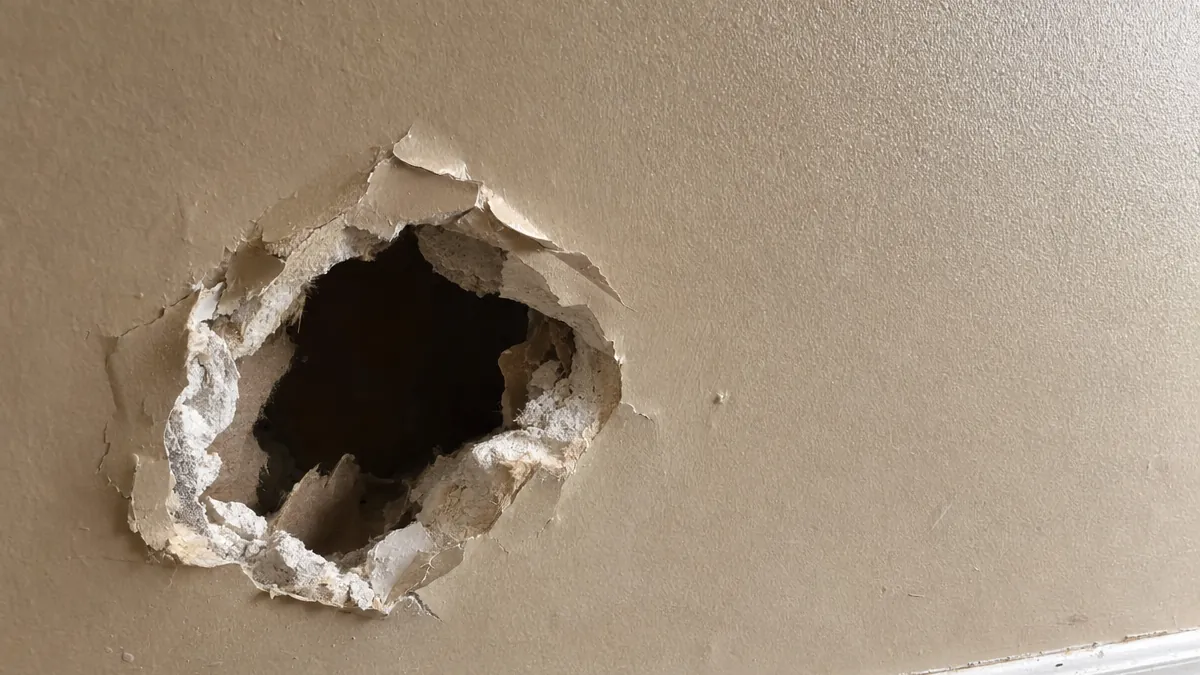
Check for water before anything else
Water is the strongest argument for replacing over patching. Press around the ring. Firm and dry means stain-blocking primer may be enough. Spongy, crumbling, or paper peeling off the core means the panel is spent and needs to go.
With 48.61 inches of rain in a typical year here, per NOAA's 1991–2020 normals, roof leaks are a factor. So are summer AC drain overflows. Either way, fix the cause and let the cavity dry before deciding. A meter reading ends the debate.
Look along the ceiling for sag
Drooping ceiling panels never truly recover. Once gypsum bellies between joists, its core has stretched or fractured. Extra screws can pull it up, but the droop returns. Drooped areas get replaced, and if the droop spans most of a room, a full ceiling may be the smarter job.
Wet and sagging? Deal with electricity first by switching off whichever breaker feeds fixtures on that ceiling. With the power down, nobody should stand underneath, and the panel should be opened before it falls.
Weigh the seams and texture
Each patch adds joints. On a smooth hallway with low-angle light, joints are harder to hide than on knockdown. A broad patch, coated and tapered far beyond its border, disappears better than a tight one. Sometimes a full sheet wall to wall is cleaner, because its edges fall at corners and trim, where joints are expected.
Treat plaster differently
Census five-year estimates ending 2024 date 425 local housing units to before 1950, and many houses of that era have plaster walls. Plaster seldom calls for whole-wall replacement. Still attached to the lath, it gets re-secured and mended. Where a section has fallen, the void is filled to the plaster's depth and skimmed. Ripping plaster out creates heavy dust and debris and, in pre-1978 houses, the lead paint hazard the EPA warns about.
Add it up
- Patch when damage is localized, the surrounding gypsum is firm and dry, and nothing droops.
- Replace a section when gypsum is spongy, wet, crumbling or drooping, or the hole is wider than one stud bay.
- Replace the sheet when damage spreads over most of it, or patches would crowd one panel.
- Keep the plaster wherever it still clings to the lath.
Still unsure? Snap it with a coin taped near the damage and send it. The contractor pricing it will say which route fits and explain why.
For the details of each patch type, read how hole patches are sized and finished. Water-stained board is covered under leak-damaged ceilings.